Will AI Replace UI/UX Designers? The Truth No One Wants to Hear

Updated: Sep 19, 2025
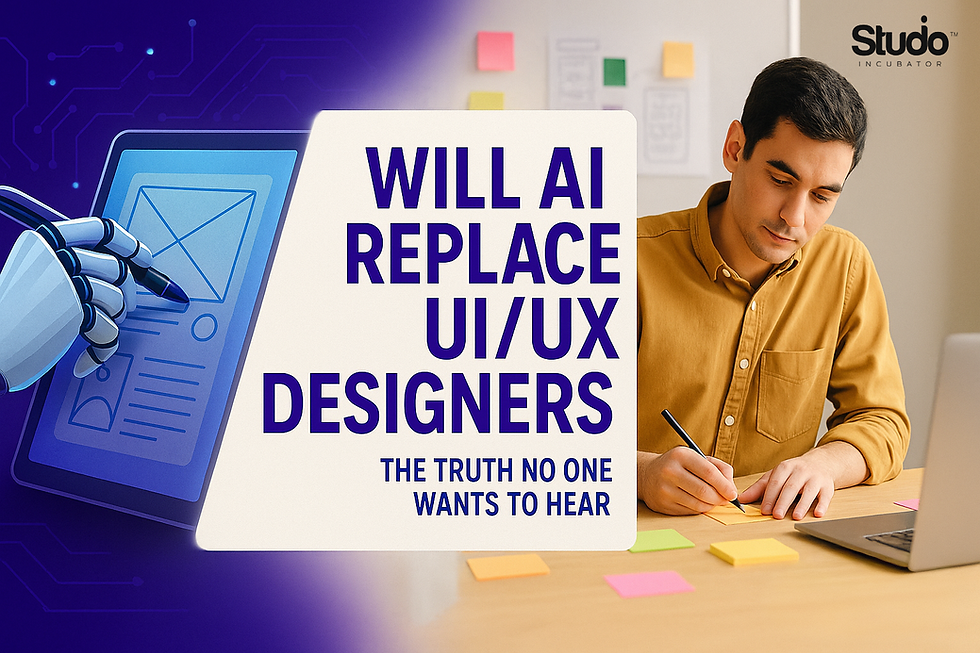
The Fear That Keeps Designers Awake at Night: "Will AI replace UI/UX designers?"
It’s the question whispered in every design Slack group, debated over coffee chats, and nervously Googled at 2 a.m.: “Will AI replace UI/UX designers?”
AI tools like MidJourney, Figma’s AI assist, and ChatGPT have already started automating wireframes, generating layouts, and even writing microcopy. For many, it feels like the robots are sneaking into the design studio, ready to take over. The fear is real—and valid. But here’s the truth no one wants to hear:
👉 AI will not replace designers. But designers who refuse to adapt will get replaced.
Why AI Alone Can’t Be a Designer
Let’s get this straight: AI is brilliant at pattern recognition and speed. It can churn out dozens of interface ideas in seconds. But design is not just about pretty pixels. Great UI/UX design is about:
Empathy: Understanding what frustrates or delights users.
Contextual Thinking: Designing not just for screens, but for real-life human journeys.
Problem Solving: Asking why a feature should exist, not just how it should look.
Storytelling: Crafting experiences that resonate emotionally and build trust.
AI can mimic patterns, but it doesn’t feel. It doesn’t understand culture, nuance, or the unspoken needs of humans. That’s where you come in.
The Designers Who Will Get Replaced
Here’s the uncomfortable reality: if your value today is limited to pushing pixels or following design trends… you’re in the danger zone. AI can already replicate that. The designers who will struggle are those who:
Lack critical thinking skills.
Fail to adapt to new tools and methodologies.
Rely solely on trends without understanding user needs.
If that sounds harsh, it’s because the market is shifting. Recruiters and companies don’t just want executors—they want thinkers. And thinkers cannot be automated.
The Future Belongs to the AI-Enhanced Designer
Imagine this: Instead of spending hours on repetitive wireframes, you let AI generate first drafts while you focus on refining the user journey. Instead of staring at a blank page for microcopy, you use AI as a springboard for creativity, adding the human warmth only you can provide.
The future designer isn’t competing with AI—they’re collaborating with it. Think of AI as your design intern: fast, eager, but needing direction. The more you can guide it strategically, the more valuable you become.
How to Future-Proof Your Design Career
So, what can you do today to stay ahead? Here’s your roadmap:
Shift from Tools to Thinking – Learn product strategy, human psychology, and business alignment.
Master Storytelling – Recruiters want to hear why you designed something, not just see screens.
Embrace AI as a Partner – Experiment with AI tools, but never let them dictate the final experience.
Build Adaptive Skills – Communication, critical thinking, and empathy will always be irreplaceable.
This is exactly why Studio Incubator’s Advanced UI/UX Master Class goes beyond teaching software. It trains you to think like a design leader—strategic, adaptive, and AI-ready.
The Real Answer to the Big Question
So, will AI replace UI/UX designers? No. But the role of a designer is transforming. The future designer is not a pixel pusher, but a strategist, storyteller, and problem-solver who uses AI as an amplifier.
Think of it like photography: when digital cameras arrived, some film photographers disappeared. But those who embraced the new tools became more creative, faster, and more impactful. The same story is unfolding in UI/UX.
The truth is, AI isn’t here to erase you—it’s here to challenge you. To evolve. To become the kind of designer who can’t be automated.
Embracing Change in Design
As the landscape of design continues to evolve, staying relevant requires a proactive approach. Embrace change, and view AI as an ally rather than a competitor. This mindset will not only enhance your skills but also open new avenues for creativity.
The Importance of Continuous Learning
In a world where technology advances rapidly, continuous learning is essential. Attend workshops, webinars, and courses that focus on both design fundamentals and emerging technologies. This will keep your skills sharp and your knowledge up-to-date.
Networking and Collaboration
Building a network of fellow designers and professionals in related fields can provide valuable insights and opportunities. Collaborate on projects, share experiences, and learn from each other. This community can be a great support system as you navigate the changing landscape of design.
Conclusion: The Path Forward
✨ Ready to future-proof your career? The journey starts with mastering not just tools, but thinking. Explore Studio Incubator’s Advanced UI/UX Master Class and transform into the designer every company will be fighting to hire.

Comments